Most borrowers negotiate two terms. There are fifteen.
I have three funding agreements on my desk. If you are trying to negotiate a merchant cash advance, the first thing worth knowing is that their factor rates are almost identical:
- Lender A - 1.35
- Lender B - 1.39
- Lender C - 1.38
Four basis points apart. If the factor rate were the only thing that mattered, these would be interchangeable deals.
Here is what they actually cost, measured the only way that counts — total dollars repaid for every dollar that landed in the bank account:
- Lender A - 1.38
- Lender B - 1.43
- Lender C - 1.47
And here is how long each takes to repay:
- Lender A - 18 months
- Lender B - 12 months
- Lender C - 7 months
Similar-looking numbers. Three completely different transactions. The spread hides in origination fees, exit charges, payment structure and prepayment terms — and every one of those is negotiable, even though most borrowers do not. They spend their leverage arguing about the factor rate and sign everything else as presented.
One thing before we get into the meat of this discussion. A merchant cash advance is expensive money, and it belongs at the end of the list — after a bank line, an SBA loan, equipment financing, a receivables facility, a raise or an investor bridge have all been looked at and ruled out. In my view there are two conditions that should both be met before you sign one: the cheaper avenues are genuinely exhausted, and the business has strong, visible cash flow going forward to carry the payments. The common and legitimate use case is exactly that combination — an unforeseen cost lands, the money is needed in days rather than months, and the revenue to repay it is already contracted or reliably recurring. If you don't have the cash flow, high interest loans and MCAs tend to deepen the problem rather than buy time to fix it. Everything below assumes you have worked through that question and concluded this is the right instrument.
What follows is a term-by-term walk through of three real agreements. I have anonymized the funders but the numbers are real. Two are structured as loans; one is a genuine merchant cash advance.
Three real MCA and revenue-based financing agreements, side by side
| Term | Lender A | Lender B | Lender C | What to ask for |
|---|---|---|---|---|
| Structure | Term loan | Term loan | True MCA (receipts purchase) | Know which one you are signing |
| Amount funded | $2.0M | $1.5M | $300K | — |
| Stated factor rate | 1.35 | 1.39 | 1.38 | Ignore it — see below |
| Cost per net dollar | 1.38 | 1.43 | 1.47 | More important than factor rate |
| Repayment period | 18 months | 12 months | ~7 months | Go for the longest period since it will reduce the cost/dollar |
| Fees at disbursement | 1.75% | 1.00% (plus 3% at exit) | 6.00% | 1% at funding, plus a full list of back-end fees |
| Payment | $69K bi-weekly, level | $21.7K for 16 wks, then $54.3K | $13.8K weekly (2.12% of revenue) | A reduced-payment opening period |
| Prepayment discount | Factor steps 1.09 to 1.23 | 6 tiers, 30–180 days | 1.08 / 1.14 / 1.20 | Tiered factor step-down |
| Prepayment window | 7 months | 6 months | 90 days | The longest window you can get |
| Discount forfeited if | Any default ever, cured or not | Default forfeits | In breach at time of exercise | "Measured at the time of exercise" |
| Exit fee | None | 3% on payoff, maturity or acceleration | None | Strike it |
| Reconciliation right | N/A (loan) | N/A (loan) | Yes, with defined timelines | Two-day turnaround, in writing |
| Confession of judgment | None | Yes, full payback amount | None | Strike it |
| UCC-1 filing | At closing | Only on breach | At closing | Avoid it with a "filing forbearance" addendum |
| Default fee | $2,500 flat | 25% of total payback | $2,500 flat | A dollar figure, not a percentage |
Is it a merchant cash advance, or a loan in disguise?
Two of these three agreements are titled "Business Loan and Security Agreement." They have a maturity date, a stated interest expense, and an unconditional promise to pay. They are loans. The industry sells them alongside merchant cash advances and borrowers shop them against one another, but legally they are a different animal.
Lender C is the real thing: a Receivables Purchase Agreement between a "Buyer" and a "Seller," with no maturity date and no fixed term. It runs until the purchased amount is collected, however long that takes. And it says so explicitly — the purchase price "is not intended to be, nor shall it be construed as a loan," and a merchant "going bankrupt or going out of business or experiencing a slowdown in business or a delay in collecting Receivables will not on its own without anything more be considered a breach."
In a true MCA, a business slowdown is not a default. The funder bought a percentage of your revenue and took the risk that the revenue shrinks. In the two loan deals, a slowdown changes nothing — you owe the full amount on schedule regardless. In a way, the factor-based loans give the lender the best of both worlds - the visibility of a set payment schedule and payoff date as well as the aggressive pricing of MCAs.
Ask: which structure is this, and where in the document does it say so?
MCA prepayment discounts: where you can reduce costs
If you negotiate one thing, negotiate this. The single largest swing in any of these deals is what it costs to get out early.
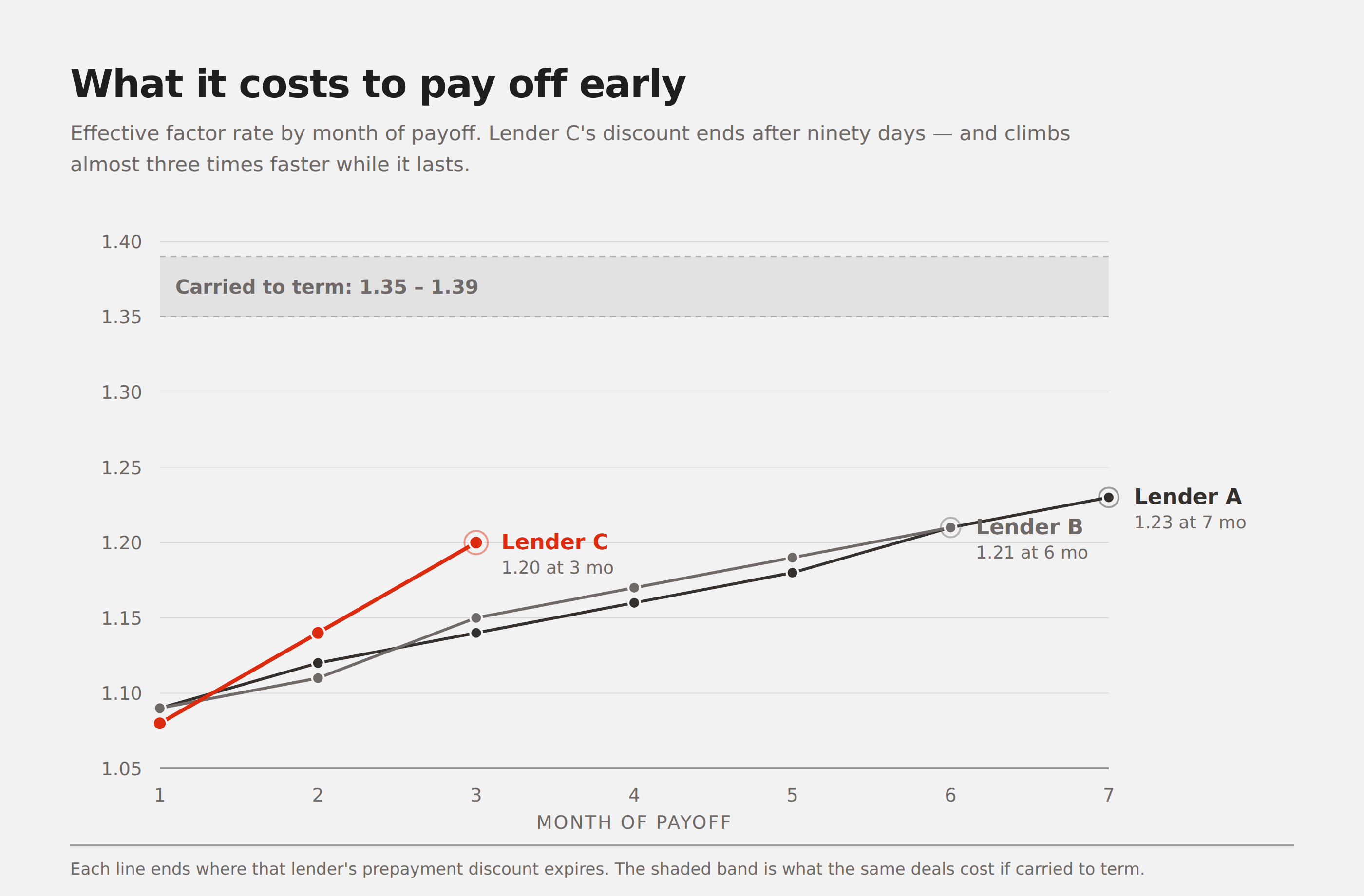
All three agreements discount the payoff if you settle ahead of schedule, and all three do it the same way — by reducing the effective factor rate. Here is what each deal actually costs at each point in its life, expressed as the factor you end up paying:
| Payoff timing | Lender A ($2.0M) | Lender B ($1.5M) | Lender C ($300K) |
|---|---|---|---|
| Paid off within 1 month | 1.09 | 1.09 | 1.08 |
| Within 2 months | 1.12 | 1.11 | 1.14 |
| Within 3 months | 1.14 | 1.15 | 1.20 |
| Within 4 months | 1.16 | 1.17 | N/A |
| Within 5 months | 1.18 | 1.19 | N/A |
| Within 6 months | 1.21 | 1.21 | N/A |
| Within 7 months | 1.23 | N/A | N/A |
| Carried to term | 1.35 | 1.39 | 1.38 |
Four things in that table are worth discussing:
The first month is priced almost identically across all three. 1.09, 1.09 and 1.08 — three unrelated funders, three deal sizes an order of magnitude apart, landing within a point of one another. Whatever else moves in a negotiation, this looks like the market floor for a thirty-day payoff. Use it as a benchmark: if a funder will not get near 1.08-1.09 at thirty days, they are not being competitive.
The discounts expire at wildly different points. Lender A’s schedule runs a full seven months. Lender B’s stops at six. Lender C’s is gone after ninety days — and since that deal is expected to take about seven months to repay, the discount is unavailable for most of the deal’s life. I've also seen agreements that stop the discounts at 60 days.
The slope matters as much as the endpoint. Lenders A and B climb gently — roughly two and a half points of factor per month. Lender C climbs six points a month, so every extra month before payoff costs nearly triple what it costs on the other two deals. A short window and a steep curve compound: Lender C is not simply offering less time, it is charging far more for each month you take.
The practical effect is large. Paying off Lender A at ninety days means $2,280,000 instead of $2,700,000 — a $420,000 difference on the same $2M advance.
Watch the size of the increments, not just the length of the window
These tiers are conventionally set in thirty-day increments, as all three deals above are. That convention is worth confirming rather than assuming, because it is not universal.
I reviewed an offer from one particularly aggressive funder that used twenty-day tiers. The schedule looked superficially similar — same number of steps, same-looking factor progression — but each step arrived ten days sooner. By day sixty a borrower was already into the third tier rather than the second, and the entire discount schedule burned out in a fraction of the time. Compressing the increments is a quiet way to make the financing substantially more expensive while the headline numbers on the page look competitive.
Ask for three things on the payoff schedule: thirty-day increments, tiers that run at least six months, and the actual dollar payoff figure at each step in writing before you sign.
One operational note: these are hard deadlines, usually requiring the funder to receive cleared funds by a stated time on the final day. Wire at least one business day early and get written confirmation of receipt. Missing a window because you missed the bank's afternoon wire deadline could cost the entire discount.
How the forfeiture clause is written also matters
All three agreements void the prepayment discount if you default. The difference is in how the condition is drafted, and the gradient is stark.
- Lender A, worst: the discount applies only if no Event of Default has occurred during the term — "without regard to whether such Event of Default has been cured or waived." One rejected ACH in month two, cured the same week, permanently destroys a six-figure option.
- Lender B, middle: an Event of Default forfeits the addendum rights.
- Lender C, best: "Seller is not in breach of this Agreement at the time Seller exercises the Early Delivery Option." Measured at the moment you exercise, so a cured problem does not disqualify you.
Ask for Lender C’s version. Nine words — measured at the time of exercise, not over the life of the deal — and a funder has already agreed to them, so it is not a theoretical request.
Get an official payoff letter before you wire the money
Whatever the schedule says, ask the funder for an official payoff letter and read it before anything moves. The letter is your check on their accounting. Their balance should reflect every weekly payment you have made, it should arrive at the discounted figure you were expecting, and it should not carry fees you did not agree to.
Discrepancies do come up. Payments get posted to the wrong date or missed altogether, and charges occasionally appear that were never part of the deal. If the balance in the letter is not what you calculated, do not wire against it and sort it out afterwards — ask the funder for the detail behind the number, payment by payment, and find where the difference is. These things are far easier to resolve before the money leaves your account than after.
Exit fees, and why one of them is harder to price than it looks
Lender B carries a fee of 3% of original principal — $45,000 on this deal. The operative clause makes it due on the earliest of full prepayment, the maturity date, or acceleration following a default. The other two agreements have nothing comparable.
Because maturity is one of the triggers, this is not really a penalty for leaving early. On a deal carried to term it is simply an additional 3% of principal collected at the back end, which is why I would treat it as part of the deal’s fee load rather than as a contingency.
Ask for the payoff figure to be confirmed in writing as all-in, and compare against your calculations. If any discrepancies, get the funder to explain and try to get it sorted out before wiring the payoff.
MCA origination fees: 1% to 6%, with smaller loans usually having higher fees on a percentage basis
Across these three deals: 1.00%, 1.75% and 6.00% — on funding of $1.5M, $2.0M and $300K respectively. That is a small sample, though it matches what I have seen elsewhere. Typically smaller deals have higher fee percentages.
On a short-duration deal the fee matters more than it looks. Six percent taken off the top of a seven-month advance is not a 6% cost spread over years — it is 6% earned in seven months, and it can move the effective rate more than several points of factor would.
Look at the whole fee load, though, not only what comes off at funding. Lender B’s 1.00% is the lowest disbursement fee in the set, and that is also the deal carrying the 3% exit fee. Carried to term, mandatory fees there come closer to 4% of principal — one point visible at closing and three collected at the end.
So ask for 1% at funding and then ask separately for a list of every fee due over the life of the deal, with the trigger for each. One of these agreements lists a $15,000 "Origination Fee" and, separately, a $15,000 "Processing Fee," without clarifying whether that is one fee described twice or two fees. Worth having the funder reconcile the fee schedule against the disbursement math before closing.
Payment structure: you are negotiating the shape, not just the size
Lender B’s payment addendum runs sixteen weeks at $21,718.75, then thirty-two weeks at $54,296.87. The opening payment is forty percent of the full payment, for four months.
For any business with a lumpy revenue cycle — production companies, seasonal operators, anyone waiting on a receivable or a rebate — that ramp can be worth more than a factor concession. It is the difference between funding the first cycle and not funding it. Lender A, by contrast, debits the same $69,230.77 every two weeks from day one.
The MCA reconciliation clause, explained
This is the provision that separates a genuine advance from a loan in disguise, and Lender C’s version is a good model.
The payment is set as an estimate of a specified percentage of revenue — here, 2.12%, producing $13,800 per week. The agreement then gives the merchant a right to true that up: request a reconciliation at any time by written notice to a dedicated address, the funder completes it within two business days of receiving proper notice, gives written notice of the determination within one business day of completion, credits back any over-collection, and resets the estimated payment going forward. Requests are explicitly unlimited.
That is a usable right, because it has deadlines and a defined process. Compare it to language letting the funder reconcile "in its discretion" or "upon review" — that is not a right, it is a courtesy.
What makes it usable in practice is a second document. This funder provided a Specified Percentage Calculation and Confirmation Addendum — a single page showing the average monthly sales figure it used, the percentage, the formula, and a signature line asking the merchant to confirm the inputs are accurate.
That is the most borrower-protective instrument in any of these three files. You cannot argue that a funder is over-collecting unless you know what the payment was supposed to approximate. Demanding this page is free, and it converts the reconciliation right from theoretical to enforceable.
Ask: a written reconciliation right with a defined turnaround, and the funder’s calculation of the specified percentage, signed.
The legal terms in an MCA contract, ranked by what they cost you
Confession of judgment
Lender B’s package includes a signed, pre-filled confession of judgment for the full $2,085,000 repayment amount, enterable without notice on default, with the funder agreeing to file a partial satisfaction crediting payments made — within seven days after judgment enters. The other two deals have none.
Ask for the following (in order of priority): strike it altogether; limit it to payment defaults only; require notice and a cure period before entry; require the partial satisfaction to be filed contemporaneously; cap the confessed amount at the discounted payoff figure rather than the full payback.
UCC-1 filings and why they cost you elsewhere
This is the highest-value ask that costs the funder nothing, and one of these borrowers got it: a one-paragraph UCC-1 Financing Statement Filing Forbearance addendum under which the funder keeps its contractual right to file but agrees to exercise it "only upon Borrower’s breach."
The reason it works is that you are not asking the funder to give up the lien. Their security position is legally identical. What changes is what your other lenders see. Banks, equipment lessors and factors all run UCC searches during underwriting, and a visible MCA lien reads as distress — it can cost you a bank line entirely independently of how the advance itself performs. You are negotiating your appearance in someone else’s credit file.
If forbearance is refused, fall back to a narrowed collateral description instead of a blanket lien, and a committed termination deadline — a UCC-3 filed within ten business days of payoff, with a consequence if they miss it.
Default fees
Lender B charges a default fee of 25% of the total original payback amount — roughly $521,000 on this deal — plus a separately stated legal fee of 25% of the same base. Lenders A and C each charge a flat $2,500. Same concept, two orders of magnitude apart. A default fee expressed as a percentage of the payback amount rather than a dollar figure is the clearest signal on the page that the funder expects you not to read it.
Who counts as the borrower
Lender B’s package defines "Borrower" to include thirteen affiliated entities as co-borrowers, cross-collateralized, plus two individuals as personal guarantors. Lender C’s exhibit grants a security interest in the receipts of eleven entities. If you run project-level or deal-level special purpose entities — production companies, real estate, anything structured deal by deal — this collapses the liability separation you built the structure to create, and it does it in an exhibit most people skim.
Negotiate the borrower definition down to the operating entity, or at minimum carve out entities with outside investors, completion guarantors, or third-party lenders who have their own views about cross-collateralization.
Stacking provisions
Lender B’s standalone stacking addendum carries a 10%-of-principal penalty — and is nonetheless better drafted than the alternative, because it names its carve-outs: bank loans, bank financing arrangements, and any financing used to pay the funder off in full. Lender A simply makes "taking additional financing from a cash advance company without prior written consent" an event of default, undefined. An explicit prohibition with named exceptions beats a vague one. Ask for the carve-outs in writing.
A right to cancel
Lender A grants rescission through midnight of the second business day after funding: return the money, the deal voids, the funder keeps only the origination fee. Real option value on a transaction negotiated under time pressure — and it exists in a signed agreement, so it is gettable.
How to actually run the negotiation
- Get two or three competing term sheets. Pricing in this market collapses under competition and holds firm without it. This is the entire ballgame.
- Ask for the payoff schedule in writing before you sign — not the factor, the actual dollar figure required to close the deal at thirty, sixty, ninety and one hundred eighty days.
- Negotiate deliberately. Funders concede structure more readily than price. Accept a shorter term or a higher payment in exchange for a longer prepayment window, a narrowed guaranty and a UCC forbearance. Those are cheap for them and can be expensive for you.
- Know your leverage moments. Before signing for the first loan is your biggest point of leverage. After that: when you are clean on payments and eligible for a renewal, and when a competing offer is live.
- Reconcile every document against every other document. Disclosure form, main agreement, payment addendum, discount addendum, fee schedule. In all three of the agreements here, there were multiple drafting errors. These MCA funders seem to be fast and loose with their paperwork!
Frequently asked questions
Are merchant cash advance terms negotiable?
Yes — far more than most borrowers assume. Pricing in this market is driven by competition rather than by a rate card, so nearly every term can move: the factor rate, the origination fee, the payment schedule, the prepayment discount and its deadline, the security interest, and the legal remedies. In the three agreements compared above, every single column differs, and each of those differences was agreed to by a funder for a borrower who asked.
What is a good factor rate for a merchant cash advance?
The factor rate alone will not tell you whether a deal is good. Three agreements with factor rates of 1.35, 1.39 and 1.38 cost 1.38, 1.43 and 1.47 per dollar actually received, over repayment periods of eighteen, twelve and seven months. Compare offers on total dollars repaid per net dollar funded, adjusted for the length of the term, and ask for the APR in writing even where the funder is not required to provide it.
Can you pay off a merchant cash advance early?
Almost always, but whether it saves you money depends entirely on the prepayment terms. Some agreements step the factor rate down by month of payoff. Others forgive only a fraction of the unearned interest. The discount is frequently contained in a separate addendum rather than in the main agreement, so ask specifically whether an early payoff addendum exists — it may not be offered unless requested.
What is a reconciliation clause in a merchant cash advance?
In a true MCA, the funder buys a set percentage of your future revenue, and the fixed weekly payment is only an estimate of that percentage. A reconciliation clause is your right to have the estimate trued up when revenue falls. A usable clause has deadlines and a defined process — for example, a request submitted in writing, completed within two business days, with over-collection credited back and the payment reset going forward. A clause that lets the funder reconcile "at its discretion" does not provide the borrower adequate protection.
Does a merchant cash advance file a UCC lien?
Usually at closing. But it is negotiable: a UCC filing forbearance addendum lets the funder keep its contractual right to file while agreeing to exercise it only if you breach. The funder’s security position is unchanged, which is why the ask often succeeds. What changes is that other lenders running a UCC search do not see an MCA lien on your business — which can otherwise cost you a bank line or credit with other lenders.
What is a confession of judgment in an MCA contract?
A pre-signed document that lets the funder enter a judgment against you on default without notice, a hearing, or an opportunity to object. Some funders no longer use them; others still include one for the full repayment amount. Ask to strike it. Failing that, limit it to payment defaults, require notice and a cure period before entry, and cap the confessed amount at the discounted payoff rather than the gross payback figure.
How much is a typical MCA origination fee?
Across the agreements discussed here, origination fees ran from 1% to 6% of the amount funded, and the smallest deal carried the highest rate. On a short-duration advance a high origination fee can move the effective rate more than several points of factor would, and it tends to be one of the more negotiable items on the term sheet. Look at the full fee load rather than the disbursement fee alone — the deal here with the lowest origination fee also carried a 3% charge at the back end.
The bottom line
The cheapest advance is usually the one you exit early. That makes the prepayment window, the forfeiture trigger and the exit fee worth more attention than the headline factor rate — which, as these three deals demonstrate, tells you little about what the money costs. Everything in the comparison table above was agreed to by a funder in this market, for a borrower who asked.
I am a fractional CFO. I read these agreements for clients before they are signed, and sometimes after, when the goal is paying them off cost effectively. If you are weighing an offer and want a second set of eyes on it, get in touch.
This article describes terms in specific agreements I have reviewed and is not legal advice, tax advice, or a recommendation about any particular financing. I am not an attorney; have counsel review any agreement before you sign it.